



Page Contents
- Let’s Talk About How to Grow Mushroom the Easy Way
- How to Grow Mushroom at Home Without Special Gear
- How to Grow Mushrooms in an Outdoor Garden
- How to Grow Gourmet Mushroom Spores from a Syringe Step by Step
- How to Grow Mushroom at Home for Business
- Final Tips from One Home Grower to Another
- Frequently Asked Questions
Let’s Talk About How to Grow Mushroom the Easy Way
If you have ever thought about growing your own mushrooms, you are in for a treat. It is simpler than most people think. Whether you want fresh mushrooms for your kitchen, a fun project with the kids, or even a small business, learning how to grow mushroom at home can be rewarding and surprisingly low cost.
I will walk you through everything step by step, like a friend showing you around their cozy grow space. No confusing science speak. Just clear, natural English.
How to Grow Mushroom at Home Without Special Gear
You do not need a lab or a greenhouse. Many beginners start with a simple kit. But if you want to learn from scratch, here is the basic process.
First, choose your mushroom type. Oyster and shiitake are great for beginners. Button mushrooms work too, but they are a little pickier.
You will need three things: spores or spawn, a growing medium (like straw, coffee grounds, or sawdust), and a container with some humidity.
Here is a simple home method using a plastic tub:
-
Pasteurize your straw or coffee grounds by pouring boiling water over them and letting them cool.
-
Mix in mushroom spawn (this is like seeds for mushrooms).
-
Put the mix in a clean plastic tub with small air holes.
-
Keep it in a dark, warm spot around 65 to 75 degrees.
-
Mist with water daily to keep it damp, not soaking.
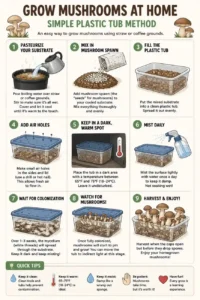
In two to three weeks, you will see white web like threads. That is called mycelium. Soon after, tiny mushrooms appear. Harvest when the caps open up.
This is the most reliable way how to grow mushroom at home without fancy equipment.
How to Grow Mushrooms in an Outdoor Garden
If you have a garden, you can grow mushrooms right in the soil or on logs. Wine cap mushrooms love wood chips in a shady garden corner. Simply spread spawn into fresh wood chips, keep them moist, and wait. In a few months, you will have mushrooms popping up after rain.
You can also grow shiitake on hardwood logs. Drill holes in the log, tap in spawn plugs, seal with wax, and stack the logs in a shady damp spot. This takes longer, about six months to a year, but it keeps producing for years.
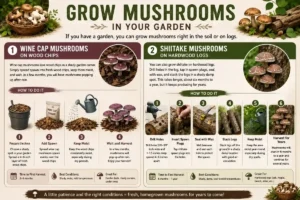
So yes, how to grow mushroom in an outdoor garden is very doable. Just remember: shade and moisture are your best friends.
How to Grow Gourmet Mushroom Spores from a Syringe Step by Step
For those ready to level up their mushroom-growing skills, using a spore syringe gives you more control over the cultivation process. A spore syringe contains mushroom spores suspended in sterile water and is commonly used for inoculating sterile substrate jars.
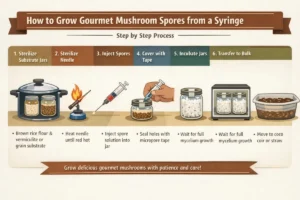
Here’s the simplified beginner-friendly process for growing legal gourmet mushrooms such as oyster mushrooms:
- Prepare and sterilize jars filled with brown rice flour and vermiculite or sterilized grain substrate.
- Flame sterilize the syringe needle until it glows red, then allow it to cool for a few seconds.
- Inject a small amount of spore solution through inoculation holes in the jar lid.
- Cover the holes with micropore tape to help maintain cleanliness while allowing airflow.
- Store the jars in a clean, warm area and wait several weeks for the substrate to become fully colonized with healthy white mycelium.
- Once colonized, transfer the substrate to a larger container with pasteurized coco coir or straw to continue the growing process.
This is the basic foundation of growing gourmet mushrooms from a spore syringe. While it requires patience and sterile technique, many growers find the process rewarding and educational.
How to Grow Mushroom at Home for Business
Once you master the basics, you can turn this into a small business. Farmers markets, local restaurants, and grocery stores love fresh gourmet mushrooms like oyster, lion’s mane, and shiitake.
Start small. Grow in buckets or reusable bags. Sell to friends and neighbors. Scale up by buying pasteurized substrate in bulk and using a small humidified tent.
Here is a quick business roadmap:
-
Master growing one variety first.
-
Track your costs (spawn, substrate, bags, water, electricity).
-
Sell fresh mushrooms for 10 to 16 dollars per pound.
-
Offer grow kits or ready to fruit blocks for extra income.
Many people successfully learn how to grow mushroom at home for business with just a spare room or basement. Just check your local rules about selling homegrown produce.
Final Tips from One Home Grower to Another
Start small. Do not overcomplicate things. Keep everything clean to avoid mold. Be patient. Mushrooms do their work quietly, and one morning you will walk in to find a beautiful cluster waiting for you.
Whether you want a garden surprise, a fun weekend project, or a new business, learning how to grow mushroom opens up a whole new world. Now go grab some spawn and give it a try. You have got this.
Frequently Asked Questions
1. How long does it take to grow mushrooms at home?
Most fast growing mushrooms like oysters take just 2 to 4 weeks from start to harvest. Shiitake and lion’s mane take a little longer, around 6 to 8 weeks. If you grow on logs outdoors, expect 6 months to a year. Patience is key, but the first time you see those little pins form, you will feel like a proud plant parent.
2. Do mushrooms need light to grow?
Mushrooms do not need light to grow like plants do. They do not perform photosynthesis. However, a little indirect light helps them know which direction to grow. A dim room or a shady corner is perfect. Too much direct sunlight will dry them out. So keep them in the dark most of the time, but a soft glow is fine.
3. Is it safe to grow mushrooms indoors near my kitchen?
Yes, it is completely safe as long as you are growing edible varieties like oyster, shiitake, or button. The only risk is mold contamination if your setup gets too wet or dirty. Keep your grow area clean and well ventilated. Do not grow mushrooms right next to your cutting board or open food. Treat it like a small indoor garden, and you will be fine.
4. Can I reuse the soil or substrate after harvesting?
You can sometimes get a second or even third flush of mushrooms from the same substrate. After harvesting, let the block rest for a week, keep it moist, and it may fruit again. But after two or three flushes, the nutrients run out. That spent substrate makes excellent compost for your garden. Do not throw it away. Your plants will love it.
5. What is the most common mistake beginners make when growing mushrooms?
Overwatering and poor air flow. Many beginners mist too much, turning the grow area into a swamp. Mushrooms need humidity, not standing water. Also, they need fresh air. Too much carbon dioxide makes them grow long and skinny with tiny caps. So mist lightly, and give them a little air exchange each day. Balance is everything.