




The Melting Pot on a Plate: How Pizza Became an American Staple
What makes a food “American”?
In the first installment of this series, we explored how the hamburger journeyed from Hamburg, Germany, to become the undisputed king of American fast food. Now, we turn our attention to another immigrant dish that has become so deeply woven into the fabric of American life that it is hard to imagine a Friday night without it: pizza.
Like the hamburger, pizza is not a native American invention. Its story is one of immigration, adaptation, and regional rivalry, a delicious testament to the idea that the most “American” foods are often the ones that traveled the farthest to get here.
From Naples to New York
The origins of pizza as we know it today can be traced back to 17th century Naples, Italy, where it was crafted as a humble, affordable dish for the working class. The classic Neapolitan pizza was a simple flatbread topped with tomatoes, mozzarella, and basil, baked quickly in a searing hot oven.
In the late 19th and early 20th centuries, millions of Italians emigrated to the United States, and they brought their culinary traditions with them. Between 1850 and 1900 alone, nearly 26 million Italians left their homeland, with many settling in American cities like New York, Chicago, and New Haven.
The first pizzeria in America is widely credited to Gennaro Lombardi, an immigrant baker from Naples. In 1905, Lombardi officially opened his pizzeria at 53 Spring Street in Manhattan’s Little Italy. Lombardi’s was more than just a restaurant. It was a community hub, a place where Lombardi helped fellow immigrants find jobs and gave them a place to live. His tomato pies were so popular that other pizzerias soon sprang up around New York, many of them founded by people who had trained in Lombardi’s kitchen.
For decades, however, pizza remained largely an ethnic food, enjoyed primarily by Italian-American communities. It was seen as a foreign, working-class dish, not something that would ever capture the heart of the entire nation.
The American Transformation: Regional Rivalries and Fast-Food Empires
Pizza’s transformation from an ethnic specialty to a national obsession happened in two distinct waves: first through regional innovation, and then through the rise of fast-food chains.
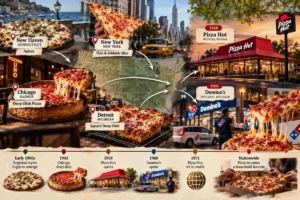
The first wave was driven by regional rivalries. In New York, pizza evolved into the thin, floppy, foldable slice that is now synonymous with the city. It was designed to be eaten on the go, a perfect meal for the bustling, fast-paced metropolis.
Then came Chicago. In 1943, a very different style of pizza was born at Pizzeria Uno. This was deep-dish pizza, a thick, bread-like crust filled with layers of cheese, chunky tomato sauce, and generous toppings. The exact inventor is a matter of heated debate. The legend credits Ike Sewell, the original owner of Uno, but pizza historians argue that the true mastermind was likely Ric Riccardo, who discovered a pizza oven and round cast iron pans in the kitchen when he took over the space. Some sources credit Uno’s manager, Rudy Malnati Sr., or his son Lou. Regardless of who deserves the credit, deep-dish pizza became a Chicago icon, a hearty, sit-down meal perfectly suited to the city’s long, cold winters.
Other regional styles began to emerge as well. New Haven, Connecticut, developed its own “apizza” style, known for its coal-fired, charred crust and white clam pie. Detroit-style pizza, baked in square automotive parts pans, developed its own devoted following.
The second wave of pizza’s American transformation came with the rise of fast-food chains. In 1958, two brothers, Frank and Dean Carney, borrowed $600 from their mother and opened the first Pizza Hut in Wichita, Kansas. By 1971, Pizza Hut was the number one pizza chain in the world, with its iconic red roof and sit-down dining experience.
Meanwhile, in 1960, Tom and Nick Monaghan founded DomiNick’s Pizza in Ypsilanti, Michigan. This small pizzeria would eventually become Domino’s, a chain built entirely around delivery. By promising 30-minute delivery, Domino’s grew into the fastest-growing pizza company in the United States and eventually surpassed Pizza Hut as the largest pizza chain in the world.
The Cultural Impact: A National Obsession
Today, pizza is more than just a food. It is a national institution.
Americans consume more than three billion pizzas every year. There are nearly 75,000 pizzerias across the country, from hole-in-the-wall slice joints to upscale artisan restaurants. Pizza is the go-to meal for birthday parties, office lunches, late-night study sessions, and Friday family dinners.
The cultural impact of pizza is perhaps best captured by the intensity of the debates it inspires. Ask a New Yorker where to get the best pizza, and you could be in for a long conversation. The rivalry between New York-style and Chicago-style pizza is legendary, a friendly (and sometimes not-so-friendly) cultural war that reflects the broader regional identities of the two cities. Even celebrities have weighed in. Comedian Jon Stewart once famously ranted that Chicago deep-dish “is not pizza. It’s a fucking casserole”.
Pizza has also become a canvas for American culinary creativity. The classic pepperoni slice is a standard, but chefs across the country have elevated pizza into a gourmet item, topped with everything from truffle oil to barbecue brisket. The regional variations continue to multiply, with styles like St. Louis (Provel cheese), California (health-conscious toppings), and Detroit (thick, rectangular, crispy-edged) all claiming their place in the American pizza pantheon.
For a deeper look at how pizza became an Ellis Island icon and a symbol of immigration, the National Park Service offers a fascinating exploration of its American journey.
And for those who want to dive into the fiercely debated origins of Chicago deep-dish, National Geographic has an excellent investigation.
The pizza’s story is a perfect example of the American melting pot in action. It began as a humble Neapolitan street food, was carried across the ocean by immigrants, and was transformed by American ingenuity, commerce, and regional pride into a global icon. It is a simple food with a complex history, a delicious reminder that the most “American” things are often the result of a journey from somewhere else.
Stay tuned for our next installment, where we’ll explore the story of another immigrant classic that became an American staple: gumbo.
In the meantime, tell us in the comments: Are you Team New York or Team Chicago?