


The Melting Pot on a Plate: How Barbecue Became America’s Original Cuisine
What makes a food “American”?
We have explored how the hamburger, pizza, and gumbo each traveled a long and winding road to become American icons. Each dish was a story of immigration, adaptation, and transformation. But the final dish in our series is different. It is not a single recipe or a specific food. It is a method, a tradition, and a social institution that is as old as America itself.
Barbecue is not just a meal. It is a ritual, a craft, and a point of fierce regional pride. It is the story of Indigenous peoples, European settlers, and enslaved Africans coming together around a fire. It is a story of survival, ingenuity, and community. And it is, perhaps, the most American food of all.
A Fire That Burned Before America
The word “barbecue” comes from the Spanish word barbacoa, which the Spanish adopted from the Taíno people of the Caribbean. The Taíno used the term to describe a wooden framework of green sticks used to cook meat over a slow fire. The first written mention of the word appeared in 1526, when Spanish explorer Gonzalo Fernández de Oviedo y Valdés used it to describe the cooking techniques he witnessed in the West Indies.
But the roots of American barbecue go deeper than any single word. Long before European colonizers arrived, Native American tribes across the continent were cooking meat over open fires. The Caddo Indians in what is now Texas were cooking venison over wood fires as far back as 10,000 years ago. These early techniques, using fire and smoke to preserve and flavor meat, laid the foundation for what would become the American barbecue tradition.
The true birth of American barbecue, however, happened in the 17th century in the slaveholding states of the American South. As Dr. Howard Conyers, a South Carolina-based pitmaster and barbecue historian, explains, “Barbecue required the hands and minds of enslaved Americans. They took Indigenous, European and African techniques and, through trial and error, put them all together.”
Enslaved Africans brought their own culinary knowledge, including a deep understanding of fire, smoke, and seasoning. European settlers contributed their livestock, particularly pigs and cattle, which adapted well to the New World. And Native Americans provided the foundational techniques of cooking meat over an open flame. It was this unlikely collaboration, born of oppression and survival, that created something entirely new.
The earliest American barbecues were enormous community events. Enslaved pitmasters would dig trenches, fill them with hot coals, and slow-cook entire animals for plantation feasts. They basted the meat with a simple “mop” of vinegar, salt, and pepper, a technique that kept the meat moist and acted as an antimicrobial agent in an era before refrigeration.
For enslaved people, barbecue was both a burden and a source of power. The pitmaster was a respected figure within the enslaved community, a keeper of knowledge and skill. And barbecue became a centerpiece of African American social life. As food historian Adrian Miller notes in his book Black Smoke: African Americans and the United States of Barbecue, barbecue gradually emerged in the 1700s when enslaved Africans prepared food for British colonists in Virginia.
After emancipation, barbecue became a means of economic independence for Black Americans. Many formerly enslaved pitmasters opened their own restaurants and stands, sharing their craft with a wider audience. Barbecue became an integral part of community life, from church picnics to political rallies. In the 1800s, barbecue was used as a political tool to recruit and butter up voters. It was also used by slaveholders as an incentive and reward for enslaved people at the end of the season.
The American Transformation: From Whole Hog to Regional Empires
For much of its history, barbecue was a regional and largely rural tradition. It was not until the late 19th and early 20th centuries that it began to evolve into the diverse, commercially viable cuisine we know today.
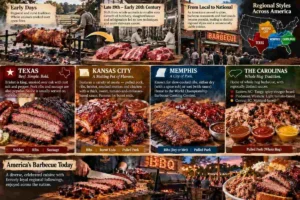
The first major transformation was the shift from whole animals to smaller cuts of meat. As barbecue moved from rural communities to cities, and as the nation’s butchery and slaughterhouse industries grew, pitmasters began cooking pork shoulders, ribs, and beef brisket instead of whole hogs and cattle. This shift, combined with the availability of refrigeration, allowed for the development of more elaborate sauces. The simple vinegar mop of the early days gave way to sweeter, tomato-based sauces.
The second transformation was the emergence of distinct regional styles, each with its own preferred meats, cooking techniques, and sauces. As more Americans moved to cities, barbecue restaurants and food stands began popping up to feed a more mobile workforce. For those in the barbecue business, it made good economic sense to cook and serve the livestock and produce that was cheapest and most readily available. Over time, these local specialties became codified as the defining characteristics of a region.
Today, there are four major regional styles, each with its own fiercely loyal following:
-
Texas: The Lone Star State is the land of beef. Texas barbecue was shaped by 19th-century German and Czech immigrants who settled in the central part of the state and brought their meat-smoking techniques with them. Brisket is king, rubbed simply with salt and coarse pepper and smoked over oak for up to 24 hours until it develops a dark “bark” and a prized pink “smoke ring.” Pork ribs and homemade sausages form the rest of the Texas “trinity.” In Texas, sauce is generally served only on the side, if at all, so as not to distract from the meat.
-
Kansas City: Kansas City is considered the melting pot of barbecue. Its style traces back to Henry Perry, a Memphis transplant who began serving barbecue from an inner-city pit in the early 1900s in the famous 18th and Vine jazz district. Kansas City barbecue features a wide variety of meats, including pulled pork, ribs, brisket, smoked mutton, and chicken, all typically served with the signature thick, sweet, tomato-and-molasses-based sauce that has become the American standard. The city is also famous for burnt ends, the crusty, fatty, flavorful nuggets cut from the point of a smoked brisket.
-
Memphis: Memphis is a city of pork. The style began in the 1920s with the city’s first barbecue joints, but it was not until 1948 that the dry rub was standardized at a restaurant called The Rendezvous. Memphis-style barbecue is slow-cooked in a pit, and ribs can be prepared either “dry” (covered with a rub of salt and spices and eaten without sauce) or “wet” (brushed with sauce before, during, and after cooking). The city is also home to the World Championship Barbecue Cooking Contest, the largest pork barbecue contest in the world.
-
The Carolinas: The Carolinas are the home of whole hog barbecue, the oldest and most traditional style. The region is also the most regionally specific when it comes to sauce. There are three key sauces: a tangy, spicy vinegar-and-pepper sauce in Eastern North Carolina; a light tomato-based sauce in the Piedmont and Western regions; and a mustard-based sauce in central South Carolina, a legacy of the German immigrants who settled there in the 18th century.
The Cultural Impact: A Social Institution
Today, barbecue is more than just a food. It is a social institution that helped shape the many regional cultures of the United States.
Barbecue is the great American equalizer. It feeds friends while they catch up, soothes tensions at political events, fuels community festivals, sustains workers of all classes, celebrates brides and grooms, and even supports churches. It is a food of the people, by the people, and for the people.
It is also a deeply personal tradition. There is no single definition of American barbecue, and there is no single “best” barbecue. Every pitmaster has their own secrets, their own techniques, their own family recipes passed down through generations. The debates over which region has the best barbecue, whether sauce belongs on ribs, and whether “fall off the bone” is a compliment or an insult are not just arguments. They are expressions of identity, heritage, and pride.
For a deeper exploration of the diverse regional styles that make up the American barbecue canon, the BBC offers an excellent journey through the United States of barbecue.
And for a look at barbecue’s roots in Indigenous, African, and European traditions, Share America provides a fascinating overview of the cuisine’s cultural history.
Conclusion: The American Recipe
The hamburger began in Germany. Pizza came from Naples. Gumbo was born of Africa, France, Spain, and the Choctaw Nation. And barbecue was a collaboration between Indigenous peoples, European settlers, and enslaved Africans on American soil.
None of these dishes were “American” in their origins. But each of them became American through a process of adaptation, fusion, and transformation. They became American because they told the story of America itself, a story of many peoples, many traditions, and many journeys coming together to create something new.
The true American cuisine is not a single dish. It is the ongoing process of creation and blending that continues today. It is the hamburger sizzling on a grill at a Fourth of July cookout, the pizza shared at a Friday night sleepover, the gumbo simmering on a Sunday afternoon, and the brisket smoking low and slow in a pitmaster’s backyard.
It is the story of a nation, told one recipe at a time.
This concludes our series on the immigrant roots of iconic American recipes. Thank you for reading.
In the meantime, tell us in the comments: What’s your favorite regional barbecue style?