



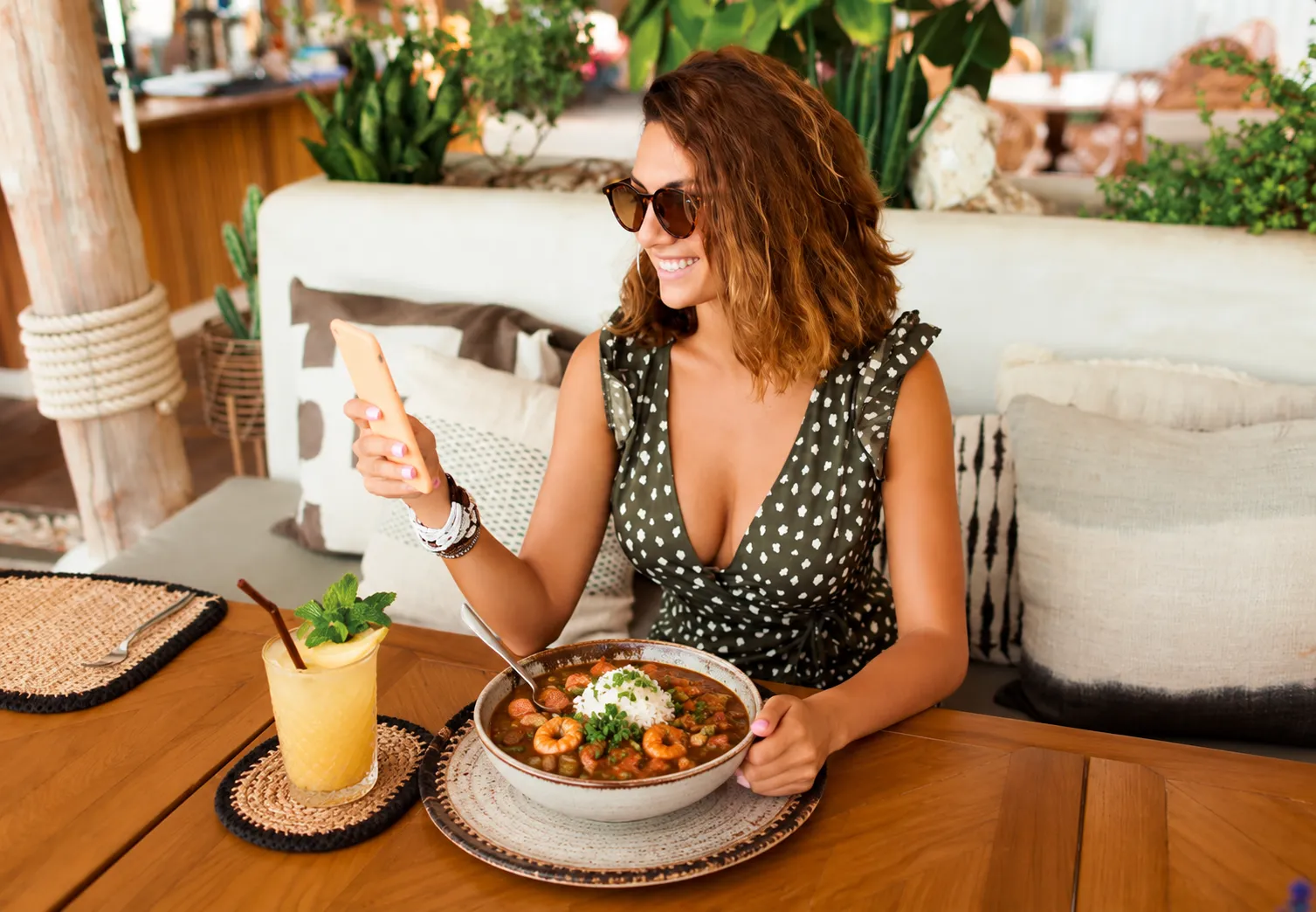
The Melting Pot on a Plate: How Gumbo Became a Symbol of Louisiana and the American South
What makes a food “American”?
In the first two installments of this series, we explored how the hamburger and pizza traveled from Germany and Italy to become American icons. Both stories are tales of immigration and adaptation, of dishes that were transformed by American commerce and regional pride.
But some American recipes tell a deeper, more complicated story. Some dishes are not just the result of one immigrant group’s journey, but of many cultures colliding, blending, and surviving together in a new world. No dish embodies this truth more powerfully than gumbo.
Gumbo is the official state dish of Louisiana, a staple of Creole and Cajun cooking, and a beloved American classic. But its story is one of the most tangled and fascinating in American food history. It is a dish born of colonialism, slavery, and cultural fusion, a bowl that contains the very history of the American South.
A Dish Born of Many Worlds
The origins of gumbo can be traced to the 18th century in southern Louisiana, a region that was then a French colony. From its earliest days, Louisiana was a cultural crossroads, and gumbo reflects every culture that passed through it.
The name itself tells part of the story. “Gumbo” likely derives from the Bantu word for okra, ki ngombo, or the Choctaw word for filé, kombo. The first known mention of gumbo in a court document dates to 1764, just a few decades after the first ships carrying enslaved Africans arrived in Louisiana.
The dish’s roots are undeniably West African. Enslaved Africans brought okra with them to the Caribbean and the American South, and they cooked it in the same ways their ancestors had for generations. In West Africa, okra stew was a staple, a thick, savory dish served with a carbohydrate like fufu. In Louisiana, that tradition evolved into something new.
But gumbo is not just an African dish. It is a fusion of many culinary traditions, each contributing a crucial element:
-
West African: Okra, the original thickening agent, and the very name of the dish.
-
French: The roux, a mixture of flour and fat cooked until it reaches a deep brown color, which gives gumbo its signature flavor and body. The French also introduced the mirepoix (carrots, onions, celery), which Cajun cooks adapted into the “holy trinity”.
-
Native American Choctaw: Filé powder, made from dried and ground sassafras leaves, which is used as a thickening agent and seasoning. Filé was first used by the Choctaw people of the American South and became essential to gumbo when okra was out of season.
-
Spanish and Caribbean: Peppers, spices, and cooking techniques that further enriched the dish.
The “holy trinity” of Cajun and Creole cooking, onions, celery, and green bell peppers, is the aromatic base of nearly every gumbo. It is a direct adaptation of the French mirepoix, with bell peppers replacing carrots, which were difficult to grow in Louisiana. The name “holy trinity” was popularized by Chef Paul Prudhomme in the late 1970s, and it has become a cornerstone of Louisiana cooking.
The American Transformation: From One Pot to Many
For much of its history, gumbo was a regional specialty, a dish cooked in homes and small cafes in and around New Orleans. It was not widely known outside of Louisiana until the 20th century.
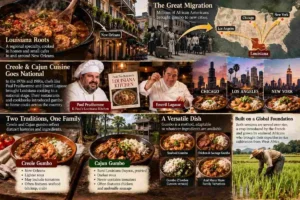
The dish’s transformation into a national icon happened gradually, driven by several forces. The first was the Great Migration, when millions of African Americans left the South for cities in the North and West, bringing their culinary traditions with them. Gumbo traveled with them, finding new audiences in places like Chicago, Los Angeles, and New York.
The second force was the rise of Creole and Cajun cuisine as a celebrated American food tradition. In the 1970s and 1980s, chefs like Paul Prudhomme and Emeril Lagasse brought Louisiana cooking to a national stage. Prudhomme’s K-Paul’s Louisiana Kitchen in New Orleans became a destination for food lovers from across the country, and his cookbooks introduced home cooks to the techniques of Cajun and Creole cooking. Gumbo was at the center of this culinary revolution.
The third force was the dish’s remarkable adaptability. Gumbo is not a single recipe. It is a method, a template that can be adapted to whatever ingredients are available. There is seafood gumbo, chicken and sausage gumbo, gumbo z’herbes (a Lenten version made with greens), and countless family variations.
The two main branches of gumbo are Creole and Cajun, and the differences between them reflect the distinct histories of the two communities:
-
Creole gumbo is associated with New Orleans and the descendants of early French and Spanish settlers, often of mixed race. It typically uses a lighter roux, may include tomatoes, and often features seafood like shrimp and crab.
-
Cajun gumbo comes from the Acadian exiles who settled in the rural bayous and prairies of Louisiana. It uses a darker roux, never contains tomatoes, and often features chicken and andouille sausage.
Both versions are served over rice, a crop that was introduced by the French and grown by enslaved Africans who brought their expertise in rice cultivation from West Africa.
The Cultural Impact: A Bowl of History
Today, gumbo is more than just a dish. It is a symbol of Louisiana, a metaphor for the state’s complex and diverse culture, and a beloved American classic.
Gumbo is often described as the perfect metaphor for Louisiana itself. The state’s folklorist, Nick Spitzer, has said that the dish’s components make it “such an appropriate metaphor for the people”. The culture of southern Louisiana has been likened to gumbo, a “strange, piquant, and savory mixture” of different peoples and traditions.
The dish crosses all class barriers. It is served in fine-dining restaurants and at casual family gatherings. It is the centerpiece of Mardi Gras celebrations and a comfort food on a cold winter night. For many Louisianians, gumbo is not just a meal; it is a connection to home, family, and heritage.
But gumbo’s story also carries a deeper, more painful truth. Its origins are inseparable from the transatlantic slave trade and the displacement of Native American peoples. As food writer John Egerton wrote, “nothing good and lasting could have come from the arbitrary confinement of black women and their white governesses to the southern kitchen…. And, we might be almost entirely right about that nothing good — except the fusion of European and African foodstuffs and culinary skills”. Gumbo is a delicious testament to the resilience and creativity of the people who created it, even in the face of immense hardship.
For a deeper exploration of gumbo’s contested origins and its role in Louisiana culture, National Geographic offers a beautifully reported investigation.
And for the story of gumbo’s journey from West African okra stew to Louisiana’s signature dish, the BBC has a fascinating account of one writer’s journey to Benin to trace the dish’s roots.
Gumbo’s story is the story of America itself. It began in many places, was carried across oceans by many peoples, and was transformed in a new world into something entirely unique. It is a dish of survival, adaptation, and fusion. It is a simple bowl of soup that contains the history of a nation.
Stay tuned for our next and final installment, where we’ll explore the story of the last great American original: barbecue.
In the meantime, tell us in the comments: Are you Team Creole or Team Cajun? Okra, filé, or roux?