




What makes a food “American”?
Is it the ingredients? The location of its invention? Or is it something more intangible, a story of adaptation, transformation, and cultural blending that becomes so deeply woven into the national fabric that we forget it was ever anything else?
The United States has often been called a “melting pot,” a place where different cultures, traditions, and peoples come together to form a new, unique whole. Nowhere is this idea more deliciously evident than on our dinner plates. Many of the dishes we consider quintessentially American are, in fact, stories of immigration and ingenuity.
This is the first in a series exploring the immigrant roots of iconic American recipes. And where better to start than with the undisputed king of American food: the hamburger.
From Hamburg to the Heartland
The story of the hamburger doesn’t begin in a diner in Ohio or a drive-through in California. It begins in the bustling port city of Hamburg, Germany. In the 19th century, a popular local dish was the “Hamburg steak,” a seasoned, chopped beef patty, often served with onions and sometimes a fried egg on top.
As German immigrants flooded into the United States in the late 1800s, they brought their culinary traditions with them. The Hamburg steak quickly became a staple in German-American restaurants and boarding houses. It was hearty, affordable, and familiar.
But it wasn’t yet a hamburger. The crucial next step, placing that beef patty between two slices of bread, is a classic American story with multiple claimants, each with a legendary origin.
-
Louis’ Lunch (New Haven, Connecticut): One of the most famous stories claims that in 1900, a customer at Louis’ Lunch was in a hurry. He asked for a quick meal he could eat on the go. The owner, Louis Lassen, grabbed a broiled beef patty, slapped it between two slices of toast, and the sandwich was born. Louis’ Lunch still operates today, serving their original, toast-based version.
-
The 1904 St. Louis World’s Fair: Another popular theory credits the fair for popularizing the burger. With thousands of visitors looking for quick, portable food, vendors began selling “hamburgers” on buns. The fair was a massive showcase for new foods (like the ice cream cone and iced tea), and the hamburger fit right in.
Regardless of the exact moment of its invention, the hamburger was the perfect food for a rapidly industrializing and modernizing America. It was fast, cheap, and satisfying, a meal built for the working class and the bustling city.
For a deeper dive into the hamburger’s contested history, the tastecooking.com offers an excellent exploration of its origins.
The American Transformation: From Diner Fare to Global Icon
The hamburger’s journey from an ethnic specialty to a national symbol is a story of American innovation and capitalism.
In the early 20th century, the burger became a staple of diners, lunch counter
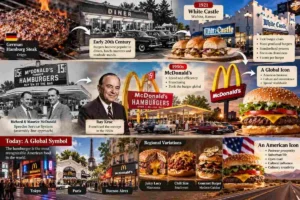
s, and roadside stands. But its true transformation came with the rise of the fast-food industry. In 1921, White Castle opened in Wichita, Kansas, and became the first restaurant chain to mass-produce and sell hamburgers. They standardized the cooking process, emphasized cleanliness, and sold their sliders for just five cents. They turned the burger into a reliable, consistent, and affordable product.
Then came the game-changer: McDonald’s.
Brothers Richard and Maurice McDonald perfected the “Speedee Service System,” an assembly-line approach to making burgers that prioritized speed and efficiency above all else. When Ray Kroc franchised their concept in the 1950s, he took the American hamburger global. The Golden Arches became a symbol not just of a meal, but of American business, culture, and convenience.
The hamburger had completed its transformation. It was no longer a German steak. It was the All-American meal, a symbol of postwar prosperity, suburban life, and the open road.
The Cultural Impact: A Global Symbol of America
Today, the hamburger is more than just a food. It is a cultural ambassador.
When you travel to Tokyo, Paris, or Buenos Aires, you will find McDonald’s, Burger King, and local chains selling their own versions of the hamburger. It is the single most recognizable American food on the planet. It represents American efficiency, capitalism, and global cultural influence, for better or for worse.
It has also become a canvas for American culinary creativity. The classic cheeseburger is a standard, but chefs across the country have elevated it into a gourmet item, topped with truffle aioli, short ribs, or high-quality aged cheddar. The regional variations are endless, from the “Juicy Lucy” in Minnesota (a burger with cheese cooked inside the patty) to the chili-topped “Chili Size” in the Southwest.
The hamburger’s story is a perfect example of the American melting pot in action. It began as a German dish, was adapted by American ingenuity, and was transformed by American commerce into a global icon. It is a simple food with a complex history, a delicious testament to the fact that the most “American” things are often the result of a journey from somewhere else.
For those interested in the broader story of American food and its immigrant roots, the National Museum of American History provides a fascinating look at how food shapes and reflects American identity.
Stay tuned for our next installment, where we’ll explore the story of another immigrant classic that became an American staple: pizza.
In the meantime, tell us in the comments: What’s your favorite regional burger style?