


Let’s be real. A pro haircut costs $60 or more these days. Learning to cut your own hair at home is a legitimate money saving skill. And no, you won’t end up with a bowl cut if you follow these practical rules.
This guide is for trimming, maintaining, and minor reshaping. If you want a complete transformation, like going from long hair to a pixie cut, go to a professional. Everything else? You have got this.
Page Contents
What You Will Actually Need (No fancy salon cart required)
You need a few basic tools. Do not skip the scissors.
-
Hair cutting shears ($15 to $25 on Amazon). Do not use kitchen scissors. They will fray your ends and cause split ends overnight.
-
Hair clippers (Wahl or Andis brand. A basic kit works fine.)
-
Fine tooth comb
-
4 to 6 alligator clips (or large plastic butterfly clips)
-
Two mirrors. One wall mirror plus a handheld mirror.
-
Old towel or a barber cape
-
Spray bottle filled with plain water
Before You Make the First Cut
Follow these rules. They matter more than your cutting technique.
-
Cut hair dry or slightly damp, never soaking wet. Wet hair shrinks as it dries. If you cut soaking wet hair, you will end up with hair that is one to two inches shorter than you planned. Mist it lightly until it feels like slightly damp laundry.
-
Start with less. Cut off half of what you think you need. You can always take more off. You cannot glue it back on.
-
Good lighting is not optional. Stand in front of a window or use bright overhead light. Shadows hide uneven spots.
-
Do not cut your own hair if you are in a bad mood. Seriously. Every hairdresser will tell you that frustration leads to bad decisions with scissors.
Step by Step: How to Trim Men’s or Women’s Hair at Home
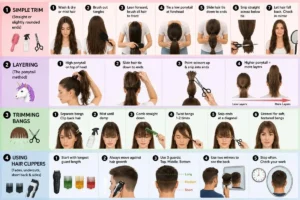
For a Simple Trim (Straight or slightly rounded ends)
This works for long hair, medium hair, and short women’s cuts.
-
Wash and dry your hair completely. Or mist it lightly until damp.
-
Brush out every single tangle.
-
Lean your head forward and brush all your hair to the front, over your face.
-
Gather it into a low ponytail right at your forehead, just above your nose.
-
Slide the hair tie down to the very ends of the ponytail.
-
Snip straight across just below the hair tie.
-
Let your hair fall back. Check in the mirror. The ends will be slightly layered and very even.
For Layering (The ponytail method)
This is the safest way for beginners to add subtle layers.
-
Pull all your hair into a high ponytail right on top of your head, like a unicorn horn.
-
Slide the hair tie down to the ends.
-
Point your scissors upward and cut into the ends, not straight across. Use small snips.
-
The higher the ponytail, the more layers you get. A low ponytail gives almost no layers.
For Trimming Bangs at Home
This is where most home haircuts go wrong. Here is the foolproof method.
-
Separate your bangs from the rest of your hair. Clip the back hair away.
-
Mist your bangs until damp.
-
Comb them straight down.
-
Twist the entire section of bangs once or twice toward the left.
-
Snip the very ends at a diagonal, not straight across.
-
Unravel. Your bangs will have a soft, textured line instead of a blunt chop.
For Using Hair Clippers (Fades, undercuts, and short back and sides)
Do not attempt a skin fade on yourself the first time. Start simple.
-
Start with the longest guard length. You can always go shorter.
-
Always move the clippers against the direction of hair growth.
-
Use three guards: longest on top, medium in the middle, shortest near the neckline.
-
Use a second mirror to see the back of your head. Hold the handheld mirror behind your head while facing the wall mirror.
-
Stop every minute. Check your work. Do not try to finish in one continuous pass.
Common Mistakes We Make (And How to Fix Them)
| Mistake | Why It Happens | Quick Fix |
|---|---|---|
| One side is longer than the other | You tilted your head while cutting | Wet your hair and recheck. Cut the longer side only. |
| Choppy, harsh lines | You cut straight across with dull scissors | Switch to point cutting (scissors pointed up into the ends) |
| Uneven layers on curly hair | You pulled curls straight while cutting | Cut curls dry and in their natural state. Do not stretch them. |
| Bald spot from clippers | You pressed too hard or used no guard | Grow it out for 2 weeks. Next time, use a guard. |
10 Quick Answers for the Home Haircutter
1. How often should I trim my own hair?
Every 6 to 8 weeks if you want to avoid split ends. Every 12 weeks if you are just maintaining length.
2. Can I use regular household scissors?
No. They are not sharp enough. They will crush and fray the hair shaft. Buy real shears.
3. What if I mess up badly?
Put down the scissors. Call a salon. Explain what happened. Most stylists can fix a bad home cut in 15 minutes.
4. Is cutting long hair at home harder or easier than short hair?
Easier. Long hair is more forgiving. Mistakes hide in the length.
5. How do I make sure both sides are even?
Check your work in the mirror three separate times. Take a photo on your phone. Flip the photo horizontally. The flipped photo will show every uneven spot instantly.
6. Should I cut wet or dry?
Damp for straight or wavy hair. Completely dry for curly hair. Never dripping wet.
7. Do I really need professional shears?
No. You need $20 shears from a beauty supply store. You do not need $200 shears.
8. How do I keep my hair healthy after a home cut?
Use a good conditioner. Stop using heat tools every day. Get a real professional cut once or twice a year to reset any unevenness.
9. Can I cut my own curly hair?
Yes, but cut it dry, curl by curl, and never pull a curl straight while cutting it.
10. What is the easiest hairstyle for a complete beginner?
A half inch trim off the ends. Nothing else. Master that first.
The Bottom Line
You will not be perfect the first time. That is fine. Start with a tiny trim. Watch your own reflection carefully. Put the scissors down when you get tired.
After two or three home cuts, you will wonder why you ever paid $60 for a simple trim. Just respect the process. Use good scissors. And for anything above your ears, consider letting a pro handle it.