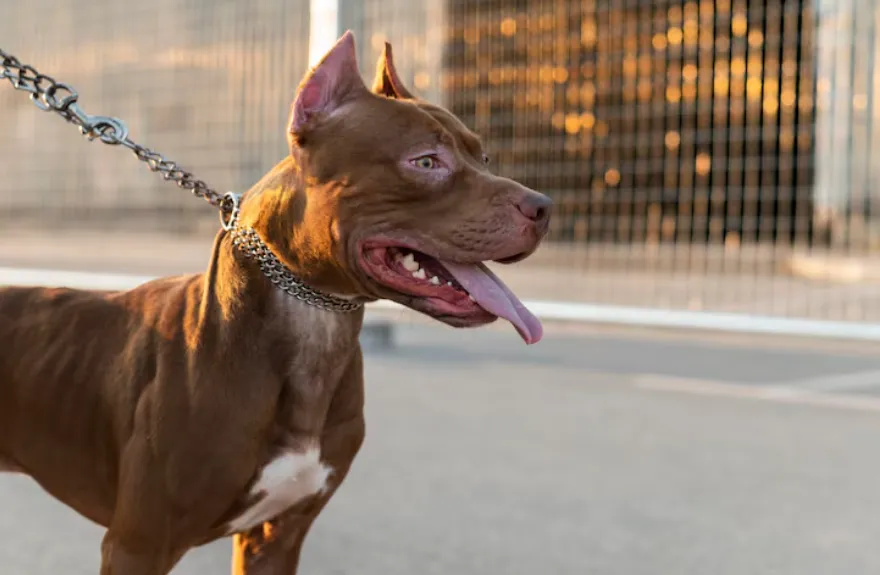

The first time I heard the barking, I was unpacking groceries. It was a Tuesday afternoon in early September, the kind of warm day that makes you leave the back door open while you put away the milk and eggs. The sound came from somewhere down the street, a high, frantic yapping that did not let up. I closed the refrigerator, listened for a moment, and went back to my routine.
By Thursday, the barking had become background noise. It started around the same time every day, late morning, and continued in bursts until the early evening. My husband noticed it during his work calls. My teenage son made jokes about it at dinner. We all agreed it was annoying, but it was not our dog and not our problem.
That is how we treated it for three weeks. As an annoyance. As someone else’s problem.
Then came the night of the storm.
It blew in around midnight, the kind of sudden thunderstorm that shakes the windows and sends the cat hiding under the bed. I woke to the sound of rain pounding against the glass and something else underneath it. The barking. It was louder now, more desperate, cutting through the wind in a way that made me sit up straight.
I lay there for a long time, listening. The storm would pass, I told myself. The dog would quiet down. But the barking did not stop. It went on between thunderclaps, a steady, frantic sound that seemed to be calling out to anyone who might be listening.
At one in the morning, I got up.
I pulled on my raincoat and an old pair of boots by the back door. My husband stirred and asked where I was going, but I did not have a good answer. I just knew I could not lie there anymore.
The rain hit my face the moment I stepped outside, cold and immediate. I followed the sound down the street, past the houses with their dark windows, past the streetlight that flickered green and yellow. The barking grew louder as I approached the small yellow house at the end of the block, the one with the overgrown bushes and the porch light that never turned on.
I had never met the people who lived there. I did not know their names or their story. But as I stood in the rain outside their fence, I could hear the dog inside, throwing itself against a door, crying now more than barking.
I knocked on the front door. No answer. I knocked again, harder. Still nothing. I walked around to the side of the house, my boots sinking into the wet grass, and found a window with a light glowing behind thin curtains. Through a gap, I could see a kitchen. Dishes in the sink. A calendar on the wall. And on the floor, a dog. Small and brown and trembling.
I went back to the front door and knocked until my hand hurt. Finally, a light came on inside. The door opened a few inches, and a woman looked out at me. She was older, maybe seventy, with gray hair pulled back and eyes that looked confused and a little afraid.
“I am so sorry,” I said, suddenly aware of how strange this must look. A soaking wet neighbor at her door in the middle of a storm. “It’s your dog. I could hear her barking from my house. I was worried something was wrong.”
The woman stared at me for a long moment. Then her face changed. The confusion faded into something else, something softer. She opened the door wider and stepped aside.
“You better come in,” she said.
Her name was Margaret. She led me through the dark living room to the kitchen, where the little brown dog was pacing in tight circles. The moment she saw us, she ran to Margaret’s feet and pressed herself against her legs, still shaking.
Margaret sat down heavily in a chair by the table. She reached down and put a hand on the dog’s head, and the trembling seemed to ease just a little.
“Her name is Penny,” Margaret said quietly. “She knows something is wrong. She has known for weeks.”
I stood there in my dripping coat, not sure what to say. Margaret looked at me, and in the kitchen light, I could see how tired she was. How thin her hands looked resting on the table.
“My husband passed in August,” she said. “Eight weeks ago yesterday. Penny was his dog, really. Followed him everywhere. When he got sick, she never left his side. And when he…” She stopped and took a breath. “When he went, she kept waiting. She still waits by the door every evening around the time he used to come home from his walk.”
The storm raged outside, but in that small kitchen, everything went quiet. I looked at Penny, still pressed against Margaret’s legs, still trembling, and I understood. The barking was not noise. It was grief.
“I did not know,” I said. “I am so sorry. I had no idea.”
Margaret shook her head. “How could you? We keep to ourselves. That was always our way. Frank and I, we liked it quiet. And now…” She looked down at Penny. “Now the quiet is the hardest part.”
I stayed for another hour. Margaret made tea, and we sat at her kitchen table while the storm moved on and the rain softened to a drizzle. She told me about Frank, about the walks they took every evening, about how Penny would run ahead and then circle back to check on them. She told me about the garden he used to keep in the backyard, the tomatoes he was so proud of, the way he would talk to the plants like they were old friends.
When I finally walked home, the sky was just beginning to lighten in the east. The streets were wet and quiet, and somewhere a bird had started to sing. I thought about all those weeks of annoyance, all those times I had rolled my eyes at the barking. I thought about Margaret alone in that house with her husband’s dog and her husband’s memory and no one to tell.
The next morning, I baked a loaf of banana bread. I walked it down to the yellow house and left it on the front step with a note that had my phone number on it. A few hours later, Margaret texted me. Just two words. “Thank you.”
That was three months ago. Now I walk Penny on Tuesday afternoons when Margaret has her doctor’s appointments. My son mows Margaret’s lawn. Last week, she came to our house for dinner and taught me how to make Frank’s famous spaghetti sauce.
The dog that would not stop barking taught me something I should have known all along. The sounds that annoy us, the disruptions in our carefully ordered days, they are not always what they seem. Sometimes they are cries for help. Sometimes they are grief wearing a different mask. Sometimes they are invitations we did not know we were waiting for.
Penny still barks. But now when I hear her, I do not roll my eyes. I walk down to the yellow house and check on my friend. And every time, that little brown dog greets me at the door like I am exactly who she has been waiting for.
