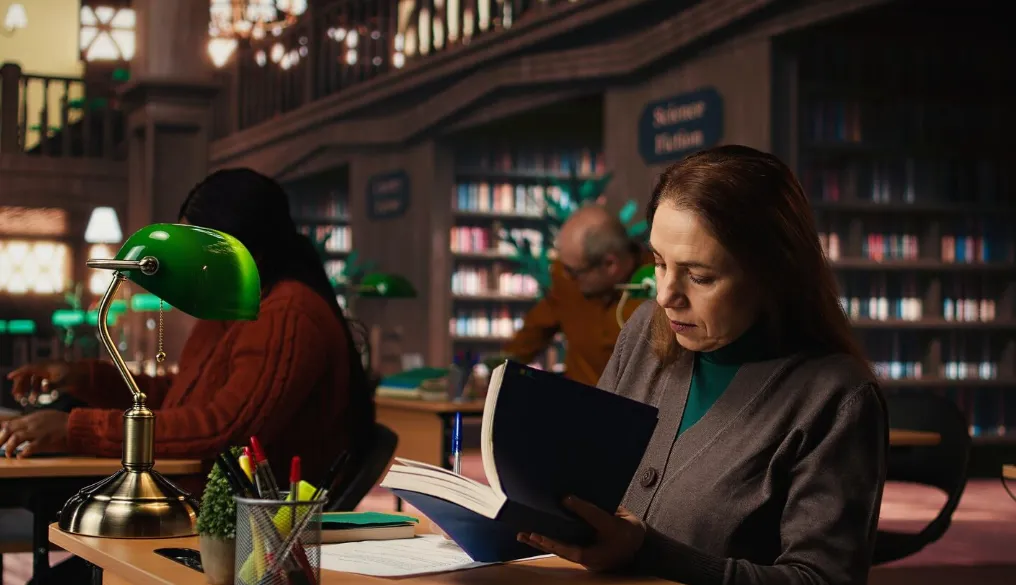

The Greenridge Library sits at the corner of Maple and Second, a sturdy brick building with wide steps that generations of children have climbed. It has the kind of windows that go all the way to the floor and a old oak tree out front that turns brilliant orange every October. I have been walking past that building for fifteen years, and until last Tuesday, I had never once walked through its doors.
It is not that I have anything against reading. I go through two or three paperback thrillers a month, the kind with detectives and twist endings that my husband leaves on the nightstand when he finishes them. It is just that buying a book from the grocery store aisle always felt easier. No due dates, no worries about coffee stains, no guilt about a book sitting untouched for weeks.
But last week, my daughter came home from school with a assignment. Her fourth grade class was doing a research project on state birds, and the requirements were specific. She needed three sources, and at least one had to be a book. Not a website, not a encyclopedia article online. A book with pages and a spine and a library stamp inside the cover.
So on Tuesday afternoon, we walked up those wide steps together and pulled open the heavy glass door.
The smell hit me first. It was paper and dust and something else, something warm like old wood and quiet afternoons. The library was nothing like I remembered from my own childhood. There were computers along one wall and bright posters advertising summer reading programs. A teenage girl sat behind a curved desk, her hair pulled back in a messy bun, tapping on a keyboard. She looked up when we walked in and smiled in a way that made me think she actually meant it.
We found the children’s section in the back, a corner with small tables and cushions shaped like ladybugs. My daughter dropped to her knees and started pulling books about birds from the lowest shelf. I stood there for a moment, watching her, and then I wandered.
That is when I saw the cart.
It was a simple metal cart, the kind hotels use for luggage, parked at the end of an aisle. On it sat a stack of books with a handwritten sign propped against them. The sign said, “Free to Good Homes. Former Library Books.”
I should have kept walking. I had come for one book about state birds, not to adopt a stack of discarded paperbacks. But my hand reached out before my brain could stop it. The top book was a collection of short stories by an author I had loved in college. The pages were yellowed and the cover was worn soft at the corners. Inside the front cover, there was a pocket. The kind they used to have before everything went digital. And inside that pocket was a card.
It was a due date card, the old fashioned kind with metal staples and rows of date stamps. The last stamp was from October 1998. Someone had checked this book out twenty-five years ago and brought it back. And now it sat on a cart, waiting for someone like me to give it a new home.
I took the book. I also took a cookbook from 1975 with pictures of gelatin salads that looked like works of art and a children’s novel about a mouse that rode a motorcycle. My daughter found me ten minutes later, clutching two books about robins and blue jays, and we carried our stack to the front desk.
The teenage girl scanned my daughter’s books first. Then she picked up my stack and paused. “Oh,” she said, looking at the collection of short stories. “These are from the cart?”
I nodded, suddenly feeling like I had done something wrong. “The sign said they were free.”
“They are,” she said quickly. “It’s just… I remember this one.” She held up the cookbook. “My grandmother used to check this out every Thanksgiving. She said it had the only cranberry recipe worth making.”
I looked at the book in a new way then. It was not just a old cookbook with strange recipes. It was a piece of someone’s holidays, a thread connecting a grandmother to her granddaughter across the years.
The girl stamped my daughter’s books and slid them across the counter. Then she handed me my stack with both hands, like she was passing me something fragile. “Enjoy them,” she said. “They’ve been waiting for someone.”
On the way out, I stopped at the front door and looked back. The library stretched out before me, row after row of shelves, each one holding stories waiting to be found. I thought about all the due dates stamped on all those cards over all those years. I thought about the people who had carried these books home, who had read them in bed or on buses or at kitchen tables, who had returned them so someone else could do the same.
I had spent fifteen years walking past this place, never understanding what I was missing. It was not just the books. It was the quiet hum of a shared space, a place where a person could sit for hours and never spend a dime. It was the teenage girl who remembered her grandmother’s cookbook and smiled at the memory. It was my daughter on her knees in the children’s section, discovering that some answers cannot be found on a screen.
We walked down the steps into the afternoon sun, my daughter swinging her bag of bird books and me clutching my stack of orphans. I will bring them back someday. Not because I have to, but because someone else might be waiting for them. And I want to know what it feels like to slide that card back into its pocket, to leave my own small mark on a date stamp, to become part of the long quiet chain that connects readers across the years.
The Greenridge Library finally has a late fee from me. I am fifteen years overdue, and it was worth every day.
