


There is a familiar rhythm to a Saturday morning at the farmer’s market. The canvas tents pop up in rows like colorful mushrooms after a rain. The air fills with the sound of friendly chatter, the clinking of glass jars, and the strumming of a local guitarist. We move through the aisles in a comfortable routine, nodding at the same farmers, reaching for the same heirloom tomatoes, and exchanging pleasantries with the baker who knows our name. It is a place of community, of predictability, a small town stage where we are all players in a weekly play.
But last Saturday, the rhythm changed.
I was standing at my usual spot, a small folding table where I sell my homemade jams and pickles. The morning had been typical, a steady stream of neighbors and friends. Around eleven, the crowd began to thin, and I took a moment to wipe down a small spill of blackberry jam. When I looked up, he was there.
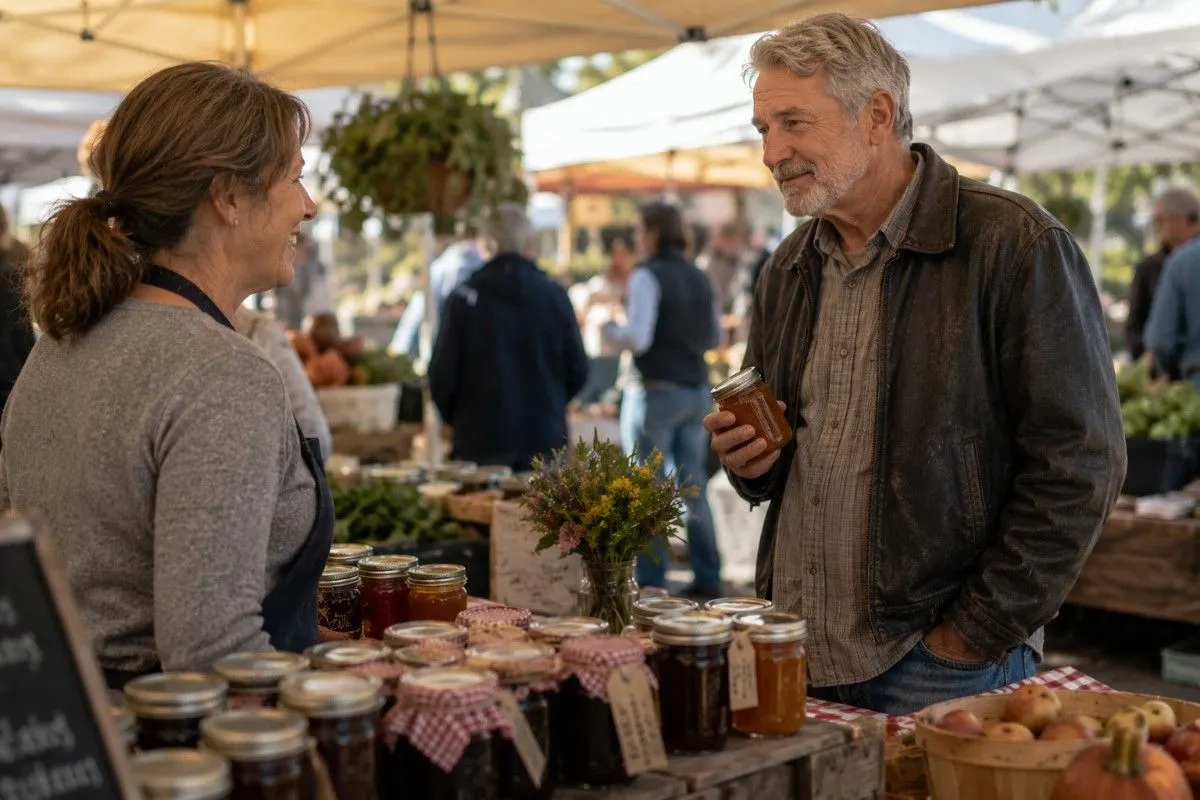
He was a stranger, and he stood out immediately. He wasn’t carrying a reusable bag or sipping a paper cup of coffee. He stood at the edge of my tent, his hands in the pockets of a worn leather jacket, just watching. His face was weathered, his eyes a pale, clear blue that seemed to be looking at everything and nothing at once. Most people at the market move with purpose. He stood perfectly still.
For a moment, I felt a flicker of unease. We are accustomed to the familiar, and the unfamiliar can sometimes feel like a disruption. But then, his eyes met mine, and he gave a small, almost shy smile. It was a disarming gesture, and I found myself smiling back.
“Good morning,” I said. “Can I interest you in a sample? The peach jam is especially good this year.”
He stepped closer, his gaze moving slowly over the rows of jars. He didn’t reach for a sample. Instead, he pointed to a small jar of my spiced apple butter. “My wife,” he said, his voice quiet and a little raspy, “she used to make this. Every fall. She’d put cinnamon and a pinch of cloves. The whole house would smell like it for days.”
The words hung in the air between us. “Used to.” It was a small phrase, but it carried a heavy weight. In that moment, the transaction shifted. It was no longer about selling a jar of preserves. It was about connection.
I took the jar of apple butter off the table and placed it gently in his hands. “Then you have to take this one,” I said. “It’s on me.”
He looked at the jar, then back at me, and for a second, I thought I saw a glint of moisture in those pale blue eyes. He shook his head slowly, a man not used to accepting charity. “No, no. I came to buy.”
“Consider it a gift,” I insisted. “A small reminder of a good memory.”
He held the jar for a long time, turning it over in his hands as if it were something precious. He told me her name was Eleanor. He told me they used to come to this very market thirty years ago, before the kids came along, before life got so busy. He had lost her last spring, and this was his first Saturday back in town. He wasn’t sure why he came. He just felt pulled.
We talked for a good ten minutes. People flowed around us, but in our small corner of the market, time seemed to slow down. I learned about Eleanor’s garden and his love of fishing. He learned about my own family and the story behind each jam recipe. He was a stranger when he arrived, but by the time he finally insisted on paying for the apple butter, pressing a crumpled five-dollar bill into my hand, he didn’t feel like one anymore.
As he walked away, disappearing into the Saturday crowd, I watched him go. The market hadn’t changed. The music still played, the people still chatted, the sun still shone. But I had changed. That brief encounter with a lonely man and a jar of apple butter was a powerful reminder of why places like the farmer’s market matter.
It’s not just about the goods. It’s about the invisible threads that connect us. It’s about the stories we carry and the simple act of sharing them. The stranger at the farmer’s market taught me that community isn’t just built by the people we see every week. Sometimes, it’s built in a single, quiet moment with someone we’ve never met before. He reminded me that in a world that often feels rushed and impersonal, a simple act of kindness, a moment of genuine listening, can be the most nourishing thing of all. We left with his money, and I like to think he left with a little piece of his past, and perhaps, a small step toward his future.